
Bildung | Education
Schulbesuch 1880 | School attendance in 1880
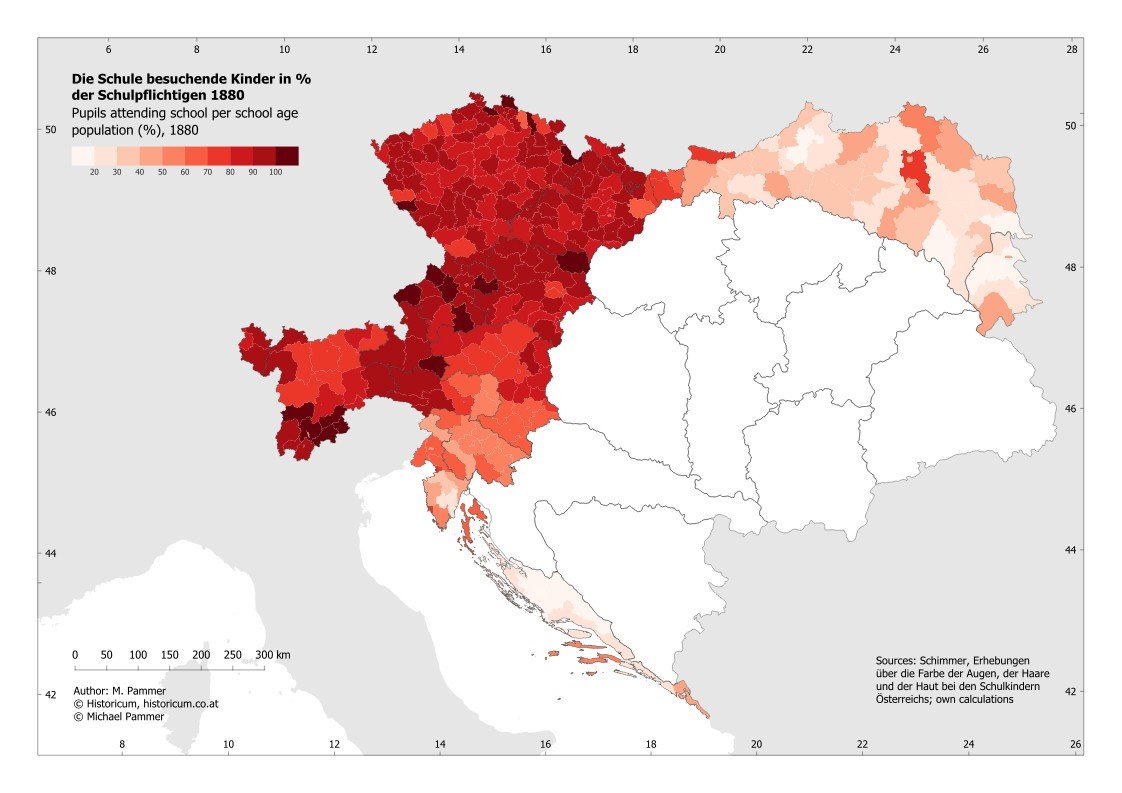
Im Zusammenhang mit der periodisch gepflogenen Detailerhebung der Volksschulen erhob man im Jahr 1880 auch die somatischen Charakteristika der österreichischen Schulkinder (Augenfarbe, Haarfarbe, Teint). Die Ergebnisse wurden separat publiziert.
Als Nebenprodukt ergab sich dabei auch die Information darüber, wie viele Kinder schulpflichtig waren und wie viele von diesen wirklich die Schule besuchten. Für die Schulpflicht galten zu diesem Zeitpunkt folgende Bestimmungen:
- Alle Kinder waren vom vollendeten 6. Lebensjahr an schulpflichtig.
- In Istrien, Dalmatien, Galizien und der Bukowina dauerte die Schulpflicht bis zum vollendeten 12. Lebensjahr.
- In allen anderen Ländern beziehungsweise im restlichen Küstenland dauerte sie bis zum vollendeten 14. Lebensjahr.
Die Karte zeigt das Verhältnis (angegeben als Prozentwerte) zwischen der Zahl der Kinder, die in die Schule gingen, und der Zahl der Schulpflichtigen. Die Schätzwerte beruhen auf den Gesamtwerten für die Kronländer und den Zahlen der somatischen Untersuchungen in den Bezirken. Da fast alle Kinder, die ihre Schulpflicht erfüllten, somatisch untersucht wurden, ist der resultierende Fehler vernachlässigbar.
Die Kinder erfüllten die Schulpflicht in manchen Gebieten nur höchst unzureichend. In Dalmatien und der Bukowina ging nur ungefähr ein Viertel der Schulpflichtigen wirklich in die Schule, in Galizien wenig mehr als ein Drittel, in Istrien 45 Prozent, in Krain, Görz und Gradiska etwa 55 Prozent. In Kärnten und der Steiermark lag die Quote bei 75 Prozent. In Schlesien gingen etwa 80 Prozent der Schulpflichtigen in die Schule, in Niederösterreich 87 Prozent, in Böhmen, Mähren und Tirol 90 Prozent. Am höchsten waren die Raten in Salzburg mit 92 Prozent und Oberösterreich mit 97 Prozent. Regional gab es Abweichungen, zum Beispiel im Trentino mit besonders hohen Raten, während das Ergebnis für Nordtirol bescheiden ausfällt. In einzelnen Gebieten sieht man auch einen Schulbesuch über die Schulpflicht hinaus.
As part of the detailed survey of primary schools carried out at regular intervals, the physical characteristics of Austrian schoolchildren (eye colour, hair colour, complexion) were also recorded in 1880. The results were published separately.
As a by-product, this also provided information on how many children were of school age and how many of them actually attended school. At that time, the following regulations applied to compulsory schooling:
- All children were required to attend school from the age of 6.
- In Istria, Dalmatia, Galicia and Bukovina, compulsory schooling lasted until the age of 12.
- In all other provinces, or in the rest of the coastal region, it lasted until the age of 14.
The map shows the ratio (expressed as a percentage) between the number of children attending school and the number of children of compulsory school age. The estimates are based on the aggregate figures for the Crown Lands and the figures from the medical examinations carried out in the districts. As almost all children of compulsory school age underwent a medical examination, the resulting margin of error is negligible.
In some areas, children’s compliance with compulsory schooling was highly inadequate. In Dalmatia and Bukovina, only about a quarter of those of school age actually attended school; in Galicia, just over a third; in Istria, 45 per cent; and in Carniola, Gorizia and Gradiska, around 55 per cent. In Carinthia and Styria, the rate stood at 75 per cent. In Silesia, around 80 per cent of school-age children attended school; in Lower Austria, 87 per cent; and in Bohemia, Moravia and Tyrol, 90 per cent. The highest rates were recorded in Salzburg at 92 per cent and Upper Austria at 97 per cent. There were regional variations; for example, Trentino had particularly high rates, whilst the figures for North Tyrol were modest. In some areas, children also attended school beyond the compulsory age.
Sie dürfen bis auf Widerruf die Inhalte dieser Seite zu nichtkommerziellen Zwecken kostenlos kopieren, weitergeben und vorführen, sofern Sie Autor und Inhaber des Copyright angeben. Eine kommerzielle Nutzung ist nicht gestattet.
The owner hereby grants a revocable, royalty-free license to reproduce, distribute, and display the content of this page for non-commercial purposes. You must include a notice on the author and the copyright holders. A commercial use is not permitted.
